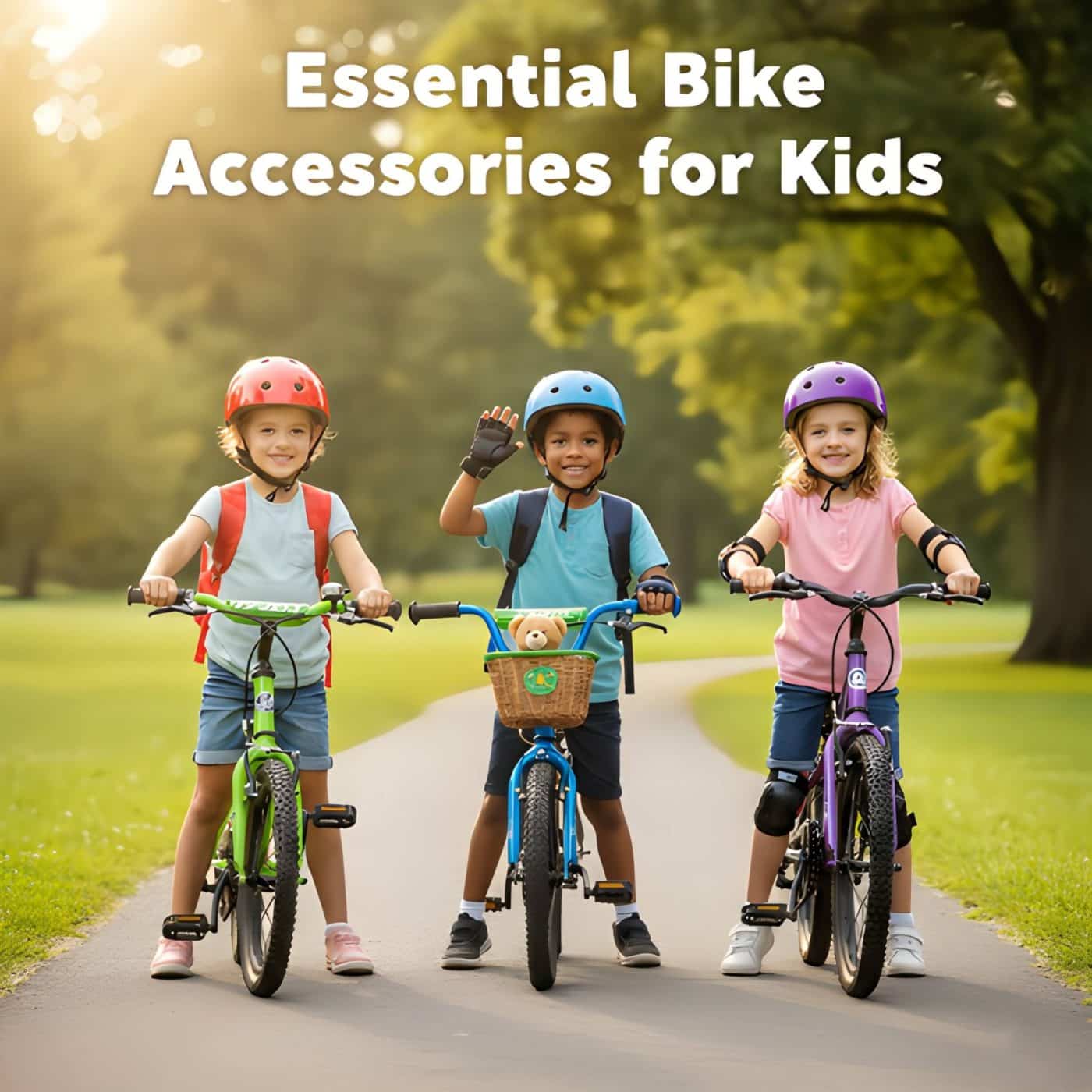
The right children bike accessories protect your kid and extend the life of their bike. Every young rider needs a certified helmet, a reliable lock, sturdy gloves, and a working pump before they hit the road.
At Kids Bikes Online, we stock every essential kids bike accessory in one place. Below, we break down exactly what to buy, why it matters, and what to look for.
The Best Kids Bike Accessories: Essential Checklist
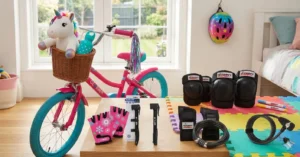
Every parent asks: what bike accessories do I need for my child? These are the best bike accessories to buy before your kid’s first ride — ranked by importance:
- Bike helmet — CPSC-certified, properly fitted to your child’s head size
- Bike lock — keeps the bike secure at school, parks, and shops
- Bike pump — maintains correct tire pressure for a safer, smoother ride
- Kids bike gloves — protect hands during falls and improve grip
- Knee and elbow pads — essential for beginner riders and younger children
- Bell or horn — required safety item for shared paths in most US states
- Reflectors or lights — critical for low-light riding visibility
Kids Bike Helmets: Safety Comes First
A helmet is the single most important children’s bike accessory you will buy. The CDC reports that helmets reduce the risk of serious head injury by up to 85%.
Every helmet we stock meets CPSC (Consumer Product Safety Commission) certification — the minimum safety standard required in the.
How to Choose the Right Size Kids Helmet
Getting the fit right is the most important step. A loose helmet offers almost no protection in a crash.
- Measure your child’s head circumference in centimeters just above the eyebrows
- The helmet should sit two finger-widths above the eyebrow line
- Straps form a “V” shape below each ear — snug but not tight
- The helmet must not rock forward, backward, or side to side when shaken
- Replace any helmet after a significant impact, even with no visible damage
Do Kids Need a MIPS Helmet?
MIPS stands for Multi-directional Impact Protection System. It is a low-friction layer inside the helmet shell that allows the helmet to rotate slightly on impact. This rotation reduces rotational force transferred to the brain during angled crashes — the most common type of bike crash.
Standard CPSC-certified helmets protect against direct impacts. MIPS adds protection against the rotational forces that standard certification does not test for. Independent testing by the Virginia Tech Helmet Lab consistently rates MIPS helmets higher than non-MIPS helmets across all price points.
Our recommendation: Choose a MIPS helmet for any child who rides on roads, shared paths, or uneven terrain. The price difference between MIPS and non-MIPS helmets in kids’ sizes is typically $10–$20. That is a small premium for a meaningful safety upgrade.
Browse our full range: Kids Bike Helmets at kidsbikesonline.com.au
Children’s Bike Gloves: Protect Small Hands
Kids bike gloves serve two purposes: grip and protection. When a child falls, hands hit the ground first. Padded palms absorb impact and prevent road rash.
Look for gloves with these features:
- Padded palm — absorbs shock and reduces road rash severity
- Velcro wrist strap — keeps gloves secure and easy for kids to put on alone
- Breathable mesh back — prevents sweaty hands on warm riding days
- Half-finger vs. full-finger — half-finger for warm weather and road riding; full-finger for mountain biking and cooler temperatures
Kids Bike Glove Size Chart
Sizing by age alone is unreliable. Kids’ hands vary significantly. Measure your child’s dominant hand across the widest part of the palm, just below the knuckles. Do not include the thumb.
| Glove Size | Hand Width | Approximate Age |
| XS (Extra Small) | 5.0 – 6.0 cm | 3 – 5 years |
| S (Small) | 6.0 – 6.5 cm | 5 – 7 years |
| M (Medium) | 6.5 – 7.0 cm | 7 – 9 years |
| L (Large) | 7.0 – 7.5 cm | 9 – 12 years |
Fitting tip: If your child is between sizes, size up. Gloves that are slightly loose are safer and more comfortable than gloves that restrict movement. A tight glove reduces grip strength.
Shop children’s bike gloves: Kids Bicycle Gloves
Bike Pumps: Keep Tires at the Right Pressure
Soft tires are one of the top causes of falls in young riders. An under-inflated tire loses its shape under load, rolls unpredictably, and increases the risk of pinch flats. A bike pump is one of the cheapest and most important bike accessories for kids.
Floor Pump vs. Hand Pump: Which Should You Buy?
| Type | Best For | Key Feature |
| Floor Pump | Home garage use, fast inflation | Pressure gauge, tall handle, stable base |
| Hand Pump | On-the-go, attaches to bike frame | Compact, dual Presta/Schrader valve head |
Our recommendation: Buy a floor pump for home use first. It inflates faster, reads pressure accurately, and is easier for kids to operate on their own. Add a hand pump once your child starts riding independently to school or the park.
Recommended PSI by Kids Bike Wheel Size
Most kids’ bikes use Schrader valves (the same as car tires). Always check the sidewall of the tire for the printed PSI range — the values below are standard starting points.
| Wheel Size | Bike Type | Recommended PSI |
| 12″ | Balance bike / toddler bike | 20 – 25 PSI |
| 14″ | Early pedal bike | 25 – 35 PSI |
| 16″ | Beginner pedal bike | 35 – 45 PSI |
| 20″ | Kids mountain / BMX / road | 40 – 65 PSI |
| 24″ | Pre-teen geared bike | 45 – 70 PSI |
Important: Always check the tire sidewall first. The PSI range is printed on every tire. Never exceed the maximum printed PSI. Over-inflation on small wheels causes hard, unstable ride quality and increases blowout risk.
Shop bicycle pumps: Bicycle Pumps at kidsbikesonline.com.au
Bicycle Locks: Keep Your Child’s Bike Secure
A kids’ bike is a real target for theft, especially at schools and parks. The right bicycle lock protects a significant investment and teaches your child to secure their bike every single time.
Best Bicycle Lock Types for Kids
- Cable lock — lightweight, flexible, easy for kids to use; best for low-risk areas and short stops
- U-lock — strongest option; recommended for school bike racks in busy areas
- Combination lock — no keys to lose; ideal for younger children who misplace things
- Chain lock — flexible like a cable but significantly harder to cut; good middle ground
How to lock correctly: Thread the lock through the frame and rear wheel, then attach to a fixed structure — a bike rack, post, or railing. Never lock through the wheel only. A thief can remove a wheel in seconds and carry the frame away.
Security rating tip: Look for locks rated “Sold Secure Bronze” or higher for everyday school use. Sold Secure is the independent UK and US standard for bicycle lock resistance testing.
Browse bicycle locks: Bicycle Locks at kidsbikesonline.com.au
Kids Protective Gear: Pads, Guards & Safety Equipment
Falls are a normal part of learning to ride. The right protective gear limits the damage. Every beginner rider and every child under 7 should wear pads on every ride.
Stock these items before your child’s first solo ride:
- Knee pads — protect the kneecap during side falls and slide-outs; the most common injury point in beginner riders
- Elbow pads — shield elbows on tarmac and gravel surfaces
- Wrist guards — absorb impact when hands hit the ground instinctively; especially important for balance bike riders transitioning to pedal bikes
- Full face helmet — recommended for mountain biking, pump tracks, and downhill riding
- Padded cycling shorts — optional but useful for longer rides; reduces saddle soreness for younger riders
Shop protective gear: Kids Protective Gear at kidsbikesonline.com.au
Children Bike Accessories by Age Group
Different ages need different gear. Use this guide to buy the right children’s bike accessories for your child’s current stage.
| Age | Bike Type | Essential Accessories |
| 2 – 4 years | Balance bike | Helmet (MIPS recommended), knee pads, elbow pads, wrist guards |
| 5 – 7 years | First pedal bike (12″ – 16″) | Helmet, gloves, pump, cable lock, bell |
| 8 – 10 years | 20″ geared bike | Helmet (MIPS), gloves, U-lock, floor pump, lights, reflectors |
| 11 – 12 years | 24″ geared or mountain bike | Helmet (MIPS), gloves, U-lock, floor pump, full-finger gloves, knee pads for trail |
When to Replace Kids Bike Accessories
Worn or damaged accessories are often worse than no accessories at all. A cracked helmet provides false confidence with no real protection. Check every item at the start of each riding season.
Helmet Replacement Guide
Replace your child’s helmet immediately after any significant crash — even if there is no visible damage. Helmet foam compresses on impact and does not recover. The protection is spent.
Replace on a schedule regardless of crashes:
- Every 3–5 years — foam degrades from UV exposure, sweat, and general wear over time
- After any crash — no exceptions, regardless of visible damage
- When the fit changes — kids grow fast; a helmet that no longer fits correctly offers no meaningful protection
- If the retention system breaks — a helmet that won’t stay on provides zero protection
Glove Replacement Guide
Kids’ gloves wear through the palm first. Inspect the palm padding every few months.
- Replace when the palm padding is worn flat or torn through
- Replace when the Velcro strap no longer holds firmly
- Replace when the gloves no longer fit — cramped gloves reduce grip strength
Bike Pump Replacement Guide
A pump with a failing gauge is one of the most common sources of over- and under-inflation accidents.
- Replace when the pressure gauge reads inconsistently
- Replace when the valve head leaks air on connection
- Replace when the barrel seal fails and pressure won’t hold
Bicycle Lock Replacement Guide
- Replace any lock that has been cut, forced, or damaged — a repaired lock is structurally compromised
- Replace cable locks every 2–3 years; cables develop micro-fractures from repeated coiling
- Upgrade to a U-lock when your child starts leaving the bike unattended at school
Frequently Asked Questions
What bike accessories do I need for my child?
Every child needs a CPSC-certified helmet, a bike lock, a pump, and gloves as the minimum set of essential bike accessories. Add knee pads and elbow pads for beginners under 7 or any child learning to ride.
What are the must-have accessories for a kids bike?
The five must-have accessories are: a certified helmet, a bike lock, a pump, gloves, and a bell. These cover safety, security, and daily maintenance. Add lights and reflectors for any riding in low-light conditions.
What age should kids start wearing bike gloves?
Kids can wear gloves from their first pedal bike ride, usually around age 4–5. Gloves protect hands during falls at any age and build good safety habits early. Size using hand width, not age alone, see the glove size chart above.
Do kids need a MIPS helmet?
MIPS helmets offer additional protection against rotational brain injury, the most common type in cycling crashes. We recommend MIPS for any child riding on roads, shared paths, or trails. The price difference is typically $10–$20 over a standard CPSC helmet.
Are bicycle spare parts available for kids bikes?
Yes. We stock bicycle spare parts including tires, tubes, brake pads, and chains compatible with common kids bike sizes (12″ through 24″). Check our accessories hub for current stock.
How often should I check my child’s tire pressure?
Check tire pressure once a week during the riding season. Kids’ bike tires lose pressure faster than adult tires because they run at lower volumes. Use the PSI chart above as a starting point, and always check the sidewall of the tire for the printed range specific to your child’s tire.
Do I need different accessories for a mountain bike vs. a road bike?
Mountain bike riders need full-face helmets (for trail and downhill), thicker full-finger gloves, knee pads, and shin guards. Road bike accessories focus on lightweight floor pumps, MIPS-certified road helmets, and a secure U-lock for urban parking. Both setups need a pump, gloves, and a lock.
![Best Kids Bikes in Australia [Top 12 List 2025]](https://kidsbikesonline.com.au/wp-content/uploads/2025/09/Best-Kids-Bikes-in-Australia-Top-12-List-2025-e1780399011614.jpg)